)

Make studying your master's in the United States possible with Prodigy Finance
Apply for your international student loan with us and finance your master's degree at one of the top US colleges
Why study in USA
Finance your master's degree in the United States with a student loan
How much money do you need to study in the USA in 2026?
There's no single visa-mandated deposit the way Germany or the UK require. The US doesn't ask you to prove a fixed sum sitting in an account for a set number of days. What it asks instead is that your I-20 shows a funding plan that covers your full cost of attendance, and that you can back that plan up at your visa interview.
Tuition for a master's runs from roughly USD 39,000 a year at a strong public university to USD 88,000 a year at a top-tier MBA program. Wharton's 2026-27 tuition alone is USD 87,970, with a total cost of attendance of USD 135,444 once housing, food and fees are added. Add visa costs on top: a USD 350 SEVIS fee and a USD 185 visa application fee.
Your I-20's cost-of-attendance figure is what a lender sizes a loan against, not your tuition bill alone. A loan that covers the gap between what you can already show and your full I-20 figure is often what turns “probably not” into a fundable visa interview.
| Key facts | |
|---|---|
| F-1 visa: SEVIS fee | USD 350, paid once your I-20 is issued |
| F-1 visa: application (MRV) fee | USD 185 |
| MBA tuition, 2026-27 | USD 87,000 to 89,000 a year at Wharton, Kellogg and Booth. Total cost of attendance closer to USD 130,000 to 141,000 a year with housing and fees |
| MS tuition, 2026-27 | USD 39,000 to 62,000 a year. Georgia Tech to Carnegie Mellon is a representative range |
| Realistic living costs | USD 1,900 to 2,750 a month in a mid-cost university town such as Pittsburgh or Atlanta. USD 3,600 to 4,000 a month in the Bay Area or Boston, per each school's own financial aid office |
| OPT work authorization | 12 months standard, plus a 24-month STEM extension: 36 months total for STEM graduates |
| F-1 admission period | Changing 15 September 2026: fixed to your program length, capped at 4 years, instead of open-ended “duration of status.” Post-completion grace period cut from 60 to 30 days |
| Work while studying | Up to 20 hours a week on campus during term. CPT and OPT allow off-campus work tied to your field of study |
| Prodigy Finance loans | Up to USD 220,000*, no co-signer, no collateral required. A separate co-signer option exists for Indian residents at a lower rate |
| How the money reaches you | Tuition paid directly to your school. Where your loan includes living costs, those are paid directly to you, into a Zolve US bank account you open as part of the process |
Visa fees alone can run past $500 before you've paid a cent of tuition.
See what you could borrow before you start budgeting for the rest.
F-1 status is no longer open-ended
Since long before most current students were born, an F-1 visa admitted a student for “duration of status.” Effectively, that meant admission for as long as they remained a full-time student in good standing, with no fixed end date on the visa itself. From 15 September 2026, that changes. A new DHS rule fixes F-1 admission to the length of your specific program, capped at four years. Anyone who wants to stay beyond that has to file an Extension of Stay directly with DHS rather than simply remaining enrolled. The post-completion grace period, the window to leave the US, start OPT, or change status after your program ends, is cut from 60 days to 30.
Two other confirmed changes sit alongside this:
A USD 100,000 fee on new H-1B petitions filed for workers currently outside the US, in place since 21 September 2025.
From 27 February 2026, H-1B selection moves from a pure lottery to wage-weighted selection. Petitions at higher wage levels get proportionally more entries, which shifts the odds against typical entry-level graduate salaries.
None of this changes the OPT or STEM OPT durations themselves. Twelve months plus a 24-month STEM extension remains 36 months total, confirmed directly in the USCIS Policy Manual. What's changing is the scaffolding around it: how long your visa admits you for, how long you have to act once your program ends, and how competitive the step after OPT has become.
Sources: Federal Register, DHS final rule establishing a fixed admission period (published 17 July 2026, effective 15 September 2026); Federal Register, Presidential Proclamation on H-1B petition fees (effective 21 September 2025); Federal Register, weighted H-1B selection final rule (effective 27 February 2026); USCIS Policy Manual, Volume 2, Part F, Chapter 5.
What studying in the USA actually costs
There's no national tuition figure. Every university sets its own, program by program, and a top MBA can cost double a strong MS in the same city.
Tuition: what you'll pay, and where
| Program type | 2026-27 tuition, per year |
|---|---|
| Top-tier MBA (Wharton, Kellogg, Booth, Stanford GSB) | USD 87,000 to 89,000 tuition. USD 130,000 to 141,000 total cost of attendance with housing and fees |
| Mid-tier or online MBA (e.g. Kelley Direct) | Roughly USD 95,000 for the full program, rate locked for the programme's length |
| MS in a strong private program (Carnegie Mellon, School of Computer Science) | USD 62,200 a year |
| MS at a strong public university (Georgia Tech, non-resident) | Roughly USD 39,000 a year |
Monthly living costs
Every figure below comes directly from that university's own financial aid office, not a survey or aggregator.
| Typical monthly cost, 2026-27 | |
|---|---|
| Bay Area or Boston (Stanford, MIT) | USD 3,600 to 4,000, per each school's own official budget. Stanford's own aid office notes off-campus living typically runs 10 to 40% higher still |
| Mid-cost university town (Pittsburgh, Atlanta) | USD 1,900 to 2,750, per Carnegie Mellon's and Georgia Tech's official budgets |
| UC Berkeley (Bay Area, but a public-university budget) | Roughly USD 2,750 |
These are financial-aid-office estimates, built to be defensible for visa and loan-sizing purposes. Real market rent, especially off-campus in New York, San Francisco or Boston, often runs above them.
Visa and one-off costs
| SEVIS I-901 fee | USD 350, unchanged since 2019 |
| DS-160 / visa application (MRV) fee | USD 185 |
| Health insurance | Set by each university, commonly USD 2,000 to 4,000 a year |
| Standardized tests | GRE/GMAT (increasingly optional, check the programme), TOEFL/IELTS where required |
How do you fund a US master's without a co-signer or collateral?
Prodigy Finance offers international student loans for master's students in the USA, sized to your future earning potential rather than your family's assets or your credit history at home. No co-signer*, no collateral required.
Every Prodigy Finance loan also includes a fixed USD 100 monthly in-school payment, starting the month after your first disbursement.* It isn't optional, but it isn't a cost added on top either. It reduces the interest accruing on your loan while you study, so you owe less once full repayment begins after your grace period.
Where your money actually goes
Tuition is paid directly to your school. Living costs work differently. Prodigy stopped certifying disbursements through schools in 2025. For US students, the living-costs portion of your loan is now paid directly to you, into a Zolve US bank account you open as part of your loan process. The Germany hub uses the same direct-to-student model through Expatrio, and the rest of the world uses Plaid.
What to do first, and what can wait
Check your eligibility early. You don't need an offer to do it.
Apply to universities. Applications go directly to each school.
Receive your I-20 once you have an unconditional offer and have shown a funding plan.
Complete your loan application and go through verification.
Pay your SEVIS fee as soon as your I-20 is issued.
Complete the DS-160 form and book your visa interview. Appointment availability is the part you control least, so start as early as you can.
Attend your interview and, once approved, plan your travel around the new fixed admission period tied to your program length.
Banks look at your family's income. We look at what you'll earn.
Check if you're eligible in a few minutes, no offer letter required.
Which US universities are best for a master's?
MIT holds the top spot globally in the QS World University Rankings 2027, released in June 2026. Several other schools Indian and international students most often apply to also sit near the top. Stanford is joint 2nd, Harvard 5th, University of Pennsylvania (home to Wharton) 15th, Cornell and Yale jointly 16th, UC Berkeley joint 20th, University of Chicago 24th, Princeton 27th, Columbia joint 43rd, Carnegie Mellon 55th, NYU 58th, and UT Austin 72nd.
| University | QS 2027 | Notes |
|---|---|---|
| MIT | 1 | Cambridge, MA. STEM-heavy, highly selective |
| Stanford | =2 | Silicon Valley proximity. GSB MBA total cost of attendance around USD 141,000 a year |
| Harvard | 5 | Broad programme range across HBS, HKS and the graduate schools |
| University of Pennsylvania | 15 | Wharton's parent institution. MBA tuition USD 87,970, 2026-27 |
| Cornell | =16 | |
| Yale | =16 | |
| UC Berkeley | =20 | Public university. Comparatively lower tuition than the private schools above it |
| University of Chicago | 24 | Booth School of Business |
| Princeton | 27 | |
| Columbia | =43 | New York City, among the highest living-cost locations on this list |
| Carnegie Mellon | 55 | Strong MS in Computer Science. Tuition USD 62,200 a year, 2026-27 |
| NYU | 58 | |
| UT Austin | 72 | Comparatively lower cost, strong technical programmes |
Sources: QS World University Rankings 2027
Schools
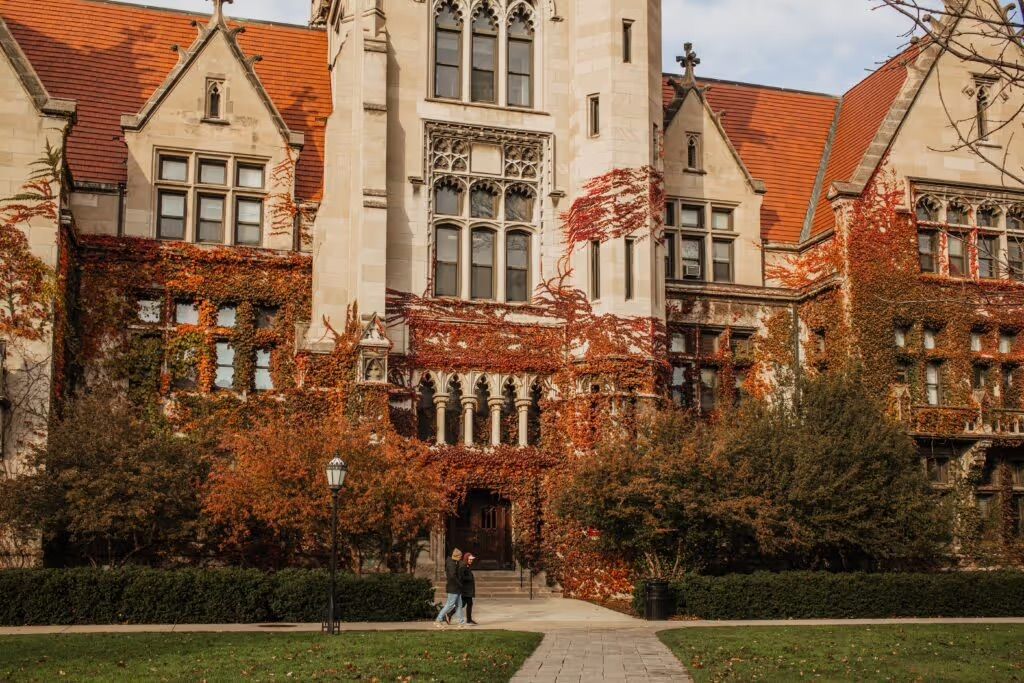
Our most popular schools in the USA
)

)

)

)

)
)

Ready to take the next step?
Explore our supported schools and start your journey today.
Getting into a US master's programme
Most master's programmes ask for a bachelor's degree in a relevant field, academic transcripts, a statement of purpose and letters of recommendation. Depending on the programme, some also ask for GRE or GMAT scores, though a growing number of schools have moved to test-optional policies. English proficiency (TOEFL, IELTS, or an equivalent) is required unless your prior degree was taught in English.
What you will need
A bachelor's degree, generally with a strong GPA. Requirements vary meaningfully by programme and school
Official transcripts from every institution attended, with certified translations if not in English
A statement of purpose specific to the programme, not a generic essay
Typically two to three academic or professional letters of recommendation
GRE or GMAT for many MS and MBA programmes. Check the specific programme page, since test-optional policies vary
TOEFL, IELTS or an equivalent, unless waived
Your timeline for a Fall 2027 start
| When | What |
|---|---|
| Now to Dec 2026 | Shortlist programmes, sit any required English or standardized tests |
| Nov 2026 to Feb 2027 | Submit applications. Deadlines are set by each school individually, and competitive programmes close early |
| Jan to Apr 2027 | Offers arrive. Accept one and confirm your funding plan |
| After acceptance | Receive your I-20 once your school confirms your funding covers your full cost of attendance |
| As soon as I-20 arrives | Pay the SEVIS fee, complete the DS-160, and book your visa interview |
| May to Jul 2027 | Attend your visa interview. Appointment availability is the least predictable part of this timeline |
| Aug to Sept 2027 | Travel and arrive under the new fixed admission period tied to your programme length |
Sources: individual university admissions pages, checked 8 September 2026; USCIS and ICE SEVIS guidance on I-20 and SEVIS fee timing.
The F-1 visa, step by step
You apply for an F-1 visa once a Student and Exchange Visitor Program (SEVP)-approved school issues your I-20 and you can clearly show how you'll fund your studies.
| Step | |
|---|---|
| 1 | Receive your I-20 from your SEVP-approved school |
| 2 | Pay the SEVIS I-901 fee: USD 350 |
| 3 | Complete the DS-160 online application form |
| 4 | Pay the visa application (MRV) fee: USD 185 |
| 5 | Book and attend your visa interview at a US embassy or consulate |
| 6 | Receive your visa decision, often the same day or within a few working days |
The documents you will need
Valid passport
I-20 form, signed by you
DS-160 confirmation page, printed
SEVIS fee receipt
Visa appointment confirmation
Financial documents: bank statements, scholarship letters, and a loan sanction letter if you're using one
Academic transcripts and university offer letter
We're not publishing a single processing-time figure. The State Department's own wait-times page explicitly disclaims precision. It calls its estimates non-binding, says they can vary week to week, and excludes any time needed for administrative processing. Check the specific embassy or consulate you'll apply at, and apply as early as your I-20 allows.
Your F-1 admission will no longer be open-ended “duration of status” from 15 September 2026. It will be fixed to your programme's length, capped at four years, with a shortened 30-day grace period after your programme ends.
Sources: ICE, I-901 SEVIS fee; U.S. Department of State, Schedule of Fees for Consular Services and Visa Wait Times; Federal Register, DHS fixed admission period rule, effective 15 September 2026.
Can international students work in the USA?
Yes, within specific limits tied to your F-1 status. On campus, you can work up to 20 hours a week during term and full-time during official breaks, with no separate authorization needed. Off campus, two programmes cover work tied to your field of study. Curricular Practical Training (CPT) covers work that's part of your curriculum, an internship for instance, while you're still enrolled. Optional Practical Training (OPT) is available both before and after graduation.
Standard OPT runs 12 months. STEM graduates can extend it by a further 24 months, 36 months total, confirmed directly in the USCIS Policy Manual. OPT and STEM OPT don't give you open-ended status. Your F-1 status now has a fixed clock attached to it regardless of which work authorization you're using.
Part-time or campus work will help with monthly costs. It won't substitute for the funding plan your I-20 requires. A US school needs to see your full cost of attendance covered by savings, scholarships, family support or a loan before it issues your I-20, not a plan to earn part of it once you arrive.
Source: USCIS Policy Manual, Volume 2, Part F, Chapter 5, Optional Practical Training.
Can you stay in the USA after your master's?
Yes, through OPT and, for STEM graduates, the STEM OPT extension, giving up to 36 months of work authorization tied to your field of study without needing an employer sponsor for that period. Beyond that, most graduates who want to stay longer need an employer to sponsor an H-1B visa.
| Stage | What it takes |
|---|---|
| OPT | Up to 12 months, tied to your field of study, no employer sponsorship needed to apply |
| STEM OPT extension | A further 24 months for STEM graduates at qualifying employers: 36 months total |
| H-1B | Needs an employer to file a petition. Since 27 February 2026, selection is wage-weighted rather than a pure lottery, which shifts the odds against typical entry-level salaries |
The H-1B route has gotten more competitive twice in the last year: first through a USD 100,000 fee on new petitions for candidates outside the US, then through the weighted lottery change. Neither directly shortens OPT or STEM OPT, but both make the step after it harder than it was for the cohort before. A student borrowing against US earnings should know that OPT is a likely couple of years, not a guaranteed pathway to a decade-long career in the US.
Sources: USCIS Policy Manual, Volume 2, Part F, Chapter 5; Federal Register, H-1B petition fee proclamation and weighted selection final rule.
VISA
Studying in the United States means entering on an F-1 student visa and maintaining your status from the moment you arrive until graduation. You must study full-time, keep your I-20 and SEVIS record updated, and hold a valid entry visa if you travel abroad and return. Your visa may expire while you remain legally in the U.S., but you’ll need a new visa stamp if you leave and re-enter.
Working during your degree (CPT + on-campus work)
You can work on campus during term time, and you may take part in internships through Curricular Practical Training (CPT) if your degree programme includes practical training. Work must be authorised before you begin — unauthorised work risks your status.
Working after graduation (OPT + STEM OPT)
Most students can apply for Optional Practical Training (OPT) for up to 12 months of work in a role related to their degree. If your degree is STEM-designated and your employer meets the requirements, you may be eligible for the 24-month STEM OPT extension, giving you up to 36 months of post-study work in total.
Employer responsibilities during STEM OPT
STEM OPT requires your employer to be enrolled in E-Verify and to provide structured, supervised training documented in Form I-983. Your work must be paid, full-time, and directly related to your studies.
Compliance matters more in 2025
U.S. authorities are applying closer scrutiny to CPT, OPT, and STEM OPT usage. Keeping accurate documents — your I-20, EAD card, training plan, job description, and travel signatures — is essential. You should avoid unauthorised employment, keep your details updated, and follow reporting deadlines.
How this supports your funding journey
Prodigy Finance loans are designed for globally mobile students, so you can focus on your studies and visa responsibilities with confidence. Your loan is disbursed directly when we send the funds to your school, and you can plan your CPT/OPT/STEM OPT stages knowing you have reliable funding in place.
Got questions before you apply ?
Whether you're still considering your loan options or have specific questions about starting your application, reach out on Whatsapp* to get quick answers.
*Responses are generated by AI and may not always be accurate or complete. For account specific information, use Lily, our chat bot on our website.
FAQ
How much does it cost to apply for an F-1 student visa in 2026?
What changed for F-1 students on 15 September 2026?
How long can I work in the USA after my master's?
What does a master's in the USA cost?
How much does it cost to live in the USA as a student?
How many hours can international students work in the USA?
When are US master's application deadlines?
Questions about our loans
Are there student loans for international students studying in the USA, without a co-signer or collateral?
Does a Prodigy Finance loan cover my full cost of attendance, including living costs?
Which US universities does Prodigy Finance support?
When do I start repaying, and what will it cost?
Can a US student loan help with visa proof of funds?
)

)
)

)
)
)

)